Emergency extraction and drying · Denton County
Water Mitigation in Denton, TX
Water mitigation is the emergency phase of a water loss: stop the water, extract it, and dry the structure before it turns into mold, warped floors, and rebuilt walls. Our water mitigation crews in Denton TX use extractors, LGR dehumidifiers, air movers, and daily moisture readings to reach a measured dry standard.
- On site in about 60 minutes in most areas
- IICRC S500 drying
- Daily moisture logs
- Works with all carriers
What water mitigation is, in plain terms
Mitigation means reducing the damage. In the restoration trade it is the work done in the first hours and days: removing water, pulling out materials that cannot be dried, and running drying equipment until the building is back to normal moisture levels. It does not include new drywall, paint, or flooring. That is the restoration or repair phase.
Speed is the whole point. The EPA advises drying water-damaged areas and items within 24 to 48 hours to prevent mold growth. Drywall wicks water upward, carpet pad holds it against the subfloor, and hardwood starts to cup as the bottom of the boards swells. Every hour of delay makes the eventual repair bigger.
Our emergency water extraction and drying teams cover Denton and the 12 other cities we serve. If you searched for water extraction in Denton TX or water removal near you, this is the service you need first.
Know what you are paying for
Water mitigation vs water damage restoration
| Mitigation | Restoration | |
|---|---|---|
| Goal | Stop damage from getting worse | Put the property back the way it was |
| When | Hours 1 to about day 5 | After materials test dry |
| Typical work | Extraction, flood cuts, pad removal, drying, antimicrobial | Drywall, texture, paint, baseboards, flooring, cabinets |
| Equipment | Extractors, LGR dehumidifiers, air movers, moisture meters, thermal cameras | Construction tools and materials |
| Insurance | Usually billed as its own line of the claim | Usually a separate repair estimate |
| Can you wait? | No. Delay adds cost and mold risk. | Yes, you can take time to choose finishes |
We do both, but you are free to use us for mitigation only and hire any contractor for the rebuild. See our residential water damage restoration page for how the full home repair works.
Before we arrive
What to do right now
- Shut off the water. Use the fixture valve or the main shutoff. In most Denton County homes the main is near the street meter or where the line enters the house.
- Kill power to wet rooms. Only from a dry spot at the breaker panel.
- Mop and blot. Towels and a wet vac help if the water is clean supply water.
- Lift furniture. Put foil or wood blocks under legs so stain and rust do not transfer to wet carpet.
- Do not run the HVAC fan if the water is dirty. It can spread odor and contamination.
- Take photos. Before you clean anything, for your claim.
IICRC S500
Water categories: how dirty is the water?
The category decides what can be saved and what protective steps are needed.
Category 1: clean
From a sanitary source, like a broken supply line, water heater, or ice maker line. Carpet and pad can often be dried in place if we reach them quickly.
Category 2: gray
Has significant contamination and can cause illness. Examples are dishwasher and washer discharge or a toilet overflow with urine only. Carpet pad is usually removed.
Category 3: black
Grossly contaminated, like sewage or floodwater that picked up soil and waste. Porous materials that touched it are removed, and crews wear protective gear.
Clean water does not stay clean. Under the IICRC standard, Category 1 water can degrade to Category 2 or 3 as it sits, warms up, and mixes with dirt and building materials. A leak found on Monday morning from a Friday break is usually no longer Category 1.
Water classes: how much has to evaporate?
The class describes how much water soaked into the building and how hard it will be to dry. It sets how many dehumidifiers and air movers the job needs.
| Class | What it looks like | Drying load |
|---|---|---|
| Class 1 | Part of a room, little wet carpet or pad, low-absorbing materials | Smallest; light equipment |
| Class 2 | At least a full room of wet carpet and pad, water wicked up walls less than 24 inches | Moderate; the most common home loss |
| Class 3 | Ceilings, walls, insulation, carpet, and subfloor soaked, often from water coming from above | Heaviest; more dehumidification |
| Class 4 | Low-permeance materials like hardwood, plaster, brick, concrete, and stone | Specialty drying; slower and targeted |
The science part
Psychrometry: why drying is more than fans
Psychrometry is the study of air and moisture. It is the reason professional water mitigation works and box fans alone do not.
Air movers push dry air across wet surfaces so water evaporates faster. That moisture goes into the air. If nothing removes it, the relative humidity climbs, evaporation slows, and water can condense on cooler surfaces or soak into materials that were dry. The dehumidifier is what pulls the water out of the building.
- Relative humidity. How full the air is compared with how much it could hold at that temperature.
- Grains per pound (GPP). The actual amount of water in the air. We compare GPP in the drying zone, outside, and at the dehumidifier exhaust to prove the equipment is working.
- Dew point. The temperature where moisture condenses. Keeping surfaces above it prevents new wetting.
- Temperature. Warm air speeds evaporation, so we manage heat as well as humidity. In a North Texas summer that can mean running the AC with the equipment; in winter it can mean adding heat.
Our process
Our water mitigation process, step by step
Inspect and map
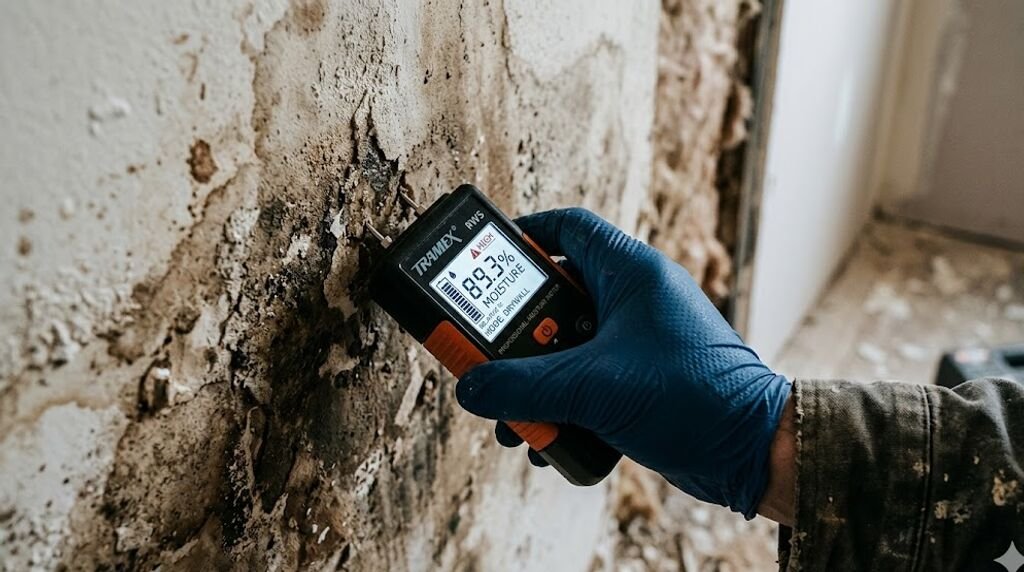
We confirm the source is stopped, set the water category, and use thermal imaging and moisture meters to find the edges of the wet area, including inside walls and under floors. Readings go on a sketch of the home.
Extract
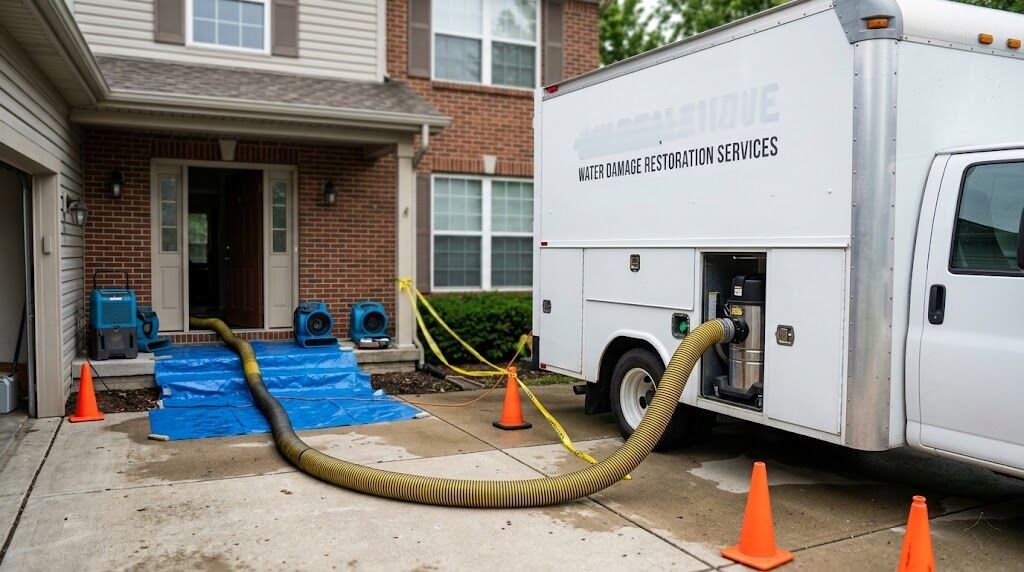
Truck-mount or portable extractors and weighted extraction tools pull water out of carpet, pad, and hard floors. Extraction is the cheapest drying there is, so we are thorough.
Remove what cannot dry
Wet pad in gray or black water losses, saturated insulation, and drywall that will not dry in place are removed. A flood cut 2 feet up opens the wall cavity. Baseboards come off so air can reach the wall bottoms.
Dry, monitor, verify
LGR dehumidifiers and air movers run around the clock. We read moisture levels every day, move equipment as areas dry, and stop only when materials match dry reference readings from unaffected parts of the house.
Between steps 3 and 4 we apply an EPA-registered antimicrobial where the water category or conditions call for it. On hardwood and slab, we may add drying mats or targeted heat, since those Class 4 materials hold water deep inside.
Equipment
The water mitigation equipment we bring
Extractors
Truck-mount and portable units with enough suction to pull water from pad and carpet, not just the surface.
LGR dehumidifiers
Low grain refrigerant units keep removing water even as the air gets dry, which ordinary dehumidifiers cannot do.
Air movers
High-velocity fans placed along wet walls, roughly one every 10 to 16 linear feet, angled to sweep the surface.
Meters and cameras
Pin and pinless moisture meters, thermo-hygrometers, and thermal imaging cameras to find and track hidden water.
Want to see how serious your situation is before you call? Try the emergency severity calculator. If anything is still actively leaking or the water is dirty, call now instead.
Water mitigation in Denton County conditions
Local climate changes how we dry. Denton gets about 37.7 inches of rain a year, and summer highs run in the 90s. In humid late spring weeks, outdoor air can carry more moisture than the air we are trying to create inside, so we keep windows closed and let the dehumidifiers do the work. In a dry winter cold snap, the opposite can be true.
Freezes are the other local pattern. During Winter Storm Uri in February 2021, the City of Denton recorded 16 water main breaks and a citywide boil notice from February 17 to 20, and burst pipes flooded buildings at UNT, TWU, and Denton ISD. When pipes break in attics and exterior walls, the loss is often Class 3 because water comes down through ceilings.
Most homes here are built on concrete slabs over clay soil. Slabs dry slowly, and wet carpet over a slab keeps it wet. That is one reason fast extraction and pad decisions matter so much on Denton County jobs.
Do not walk into standing water where outlets, cords, or appliances are submerged. Stay out of rooms with sagging ceilings; wet drywall ceilings can fall without warning.
Cost factors and insurance for water mitigation
Mitigation is priced mostly on the area affected, the water category, how many pieces of equipment run and for how many days, and how much material has to come out. A Category 1 leak caught in an hour costs far less than the same leak found three days later. We do not give fixed prices without an inspection, but the water damage cost calculator gives a rough range.
Most homeowners policies cover sudden and accidental water release, such as a burst supply line, and the mitigation that follows. Long-term leaks, rising floodwater, and sewer backup without an endorsement are common exclusions. Insurers also expect you to take reasonable steps to prevent further damage, which is exactly what mitigation is. We can work directly with your insurance company and send moisture logs, photos, and an itemized estimate. The insurance claim coverage estimator helps you think through your deductible.
DIY or professional mitigation?
- DIY is reasonable for a small clean-water spill on hard floors that you caught right away.
- Call a pro if carpet and pad are soaked, water went into walls or ceilings, the water is gray or black, or it sat more than a day.
- Household dehumidifiers are not built for this load and cannot reach the low humidity LGR units can.
Near you
Water mitigation available in every city we serve
- Denton Water Mitigation
- Corinth Water Mitigation
- Lake Dallas Water Mitigation
- Argyle Water Mitigation
- Krum Water Mitigation
- Ponder Water Mitigation
- Little Elm Water Mitigation
- Lewisville Water Mitigation
- Flower Mound Water Mitigation
- Carrollton Water Mitigation
- Coppell Water Mitigation
- Northlake Water Mitigation
- Justin Water Mitigation
FAQ
Water mitigation questions
How long does water mitigation take?
Most Class 1 and 2 losses reach dry standard in about 3 to 5 days. Hardwood, concrete, and plaster can take longer. We read moisture every day and remove equipment only when materials match dry reference readings.
Can I stay in my home during drying?
Usually, yes, for clean water losses. The equipment is loud and adds heat, so bedrooms near the work may be uncomfortable. With sewage or heavy demolition, we may suggest staying elsewhere until the area is cleaned.
Why do you remove baseboards and cut drywall?
Water wicks up drywall and hides behind baseboards. Opening the bottom of the wall lets air reach the cavity so it dries in days instead of weeks and does not grow mold inside.
Can wet carpet be saved?
Often, if the water was clean and we reach it quickly. The pad under it is usually replaced in gray water losses. Carpet and pad that touched black water or sewage are removed.
Why can’t I turn the equipment off at night?
Drying depends on steady airflow and dehumidification. Turning units off lets humidity climb back up and can add days to the job. If noise is a problem, tell us and we will adjust placement.
Is water mitigation the same as water extraction?
Extraction is one step of mitigation: removing liquid water. Mitigation also includes removing wet materials, drying the structure, and monitoring until it is dry.